Trusted by global industrial leaders




Craft beverage operators running 2–8 sites after an acquisition face fragmented visibility, incompatible equipment, and no shared production language. Download the framework your integration team needs.
Average OEE uplift delivered within the first 90 days of standardized deployment
Facilities unified on a single intelligence layer
Standard deployment timeline to production visibility
Trusted by global industrial leaders
PE-backed consolidations price in assets, brand equity, and distribution. They rarely price in the operational fragmentation that follows. When two or eight plants each have their own PLCs, reporting formats, and quality standards, standardization becomes your largest unplanned capex.
Each plant defines OEE, downtime, and quality differently. Consolidating them into a single P&L is guesswork.
Plant managers pull shift reports manually. Corporate sees performance data that is days old. Decisions made on stale information cost throughput.
Acquired plants run Siemens, Allen-Bradley, Mitsubishi, and legacy proprietary systems. Each requires different integration lift—and none of them talk to your ERP.
18-to-36-month IT roadmaps for ERP harmonization leave operations invisible to corporate during the most critical window post-acquisition.
Best-performing plants can't share what's working. Quality procedures, changeover sequences, and energy benchmarks live in people's heads—not systems.
Paper-based quality records, disconnected batch logs, and manual SPC processes increase regulatory risk at exactly the moment investor scrutiny is highest.
The solution
A unified digital factory platform connects multi-OEM shop-floor assets, standardizes KPI definitions, and creates a single source of truth that both plant managers and corporate can act on—without replacing existing equipment or waiting for an ERP cutover.
The Post-Acquisition Standardization Audit Framework gives your integration team a structured 14-page diagnostic to identify where fragmentation is costing you the most—and prioritize what to connect first.
Vendor-neutral connectivity — connect Siemens, Allen-Bradley, Mitsubishi, and legacy PLCs in a single pass without replacing hardware
Standardized KPI definitions — OEE, downtime categorization, quality thresholds, and energy intensity aligned across all plants
4-week deployment — pre-configured beverage industry templates get your first plant live in 30 days, not 18 months
ERP bi-directional sync — connects to SAP, Oracle, and Microsoft Dynamics without disrupting your cutover timeline
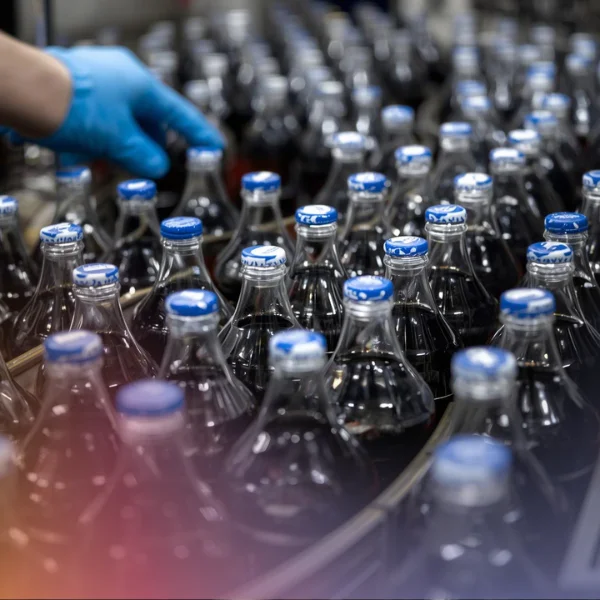
Four capability pillars that map directly to the integration priorities of post-acquisition beverage operations.
Standardize batch consistency checks and digital quality workflows across all acquired plants. Audit-ready records from day one.
Real-time OEE tracking and automated downtime analysis across every line and plant. Identify which site is hiding the most recoverable throughput.
Normalize energy and water intensity metrics across sites. Spot the plants burning utilities above benchmark before the next board review.
ML models trained on your standardized data surface failure patterns before they stop lines. Ask DFX natural-language questions about performance across all plants.
A modular deployment path that starts with your highest-risk plant and scales to enterprise-wide standardization without a big-bang rollout.
Connect shop-floor assets (PLCs, sensors) and ERP data from all acquired plants into a single, secure source of truth—regardless of OEM or vintage.
Stabilize operations with real-time OEE dashboards, cross-site loss analysis, and diagnostic tools that benchmark plant against plant.
Leverage ML for predictive maintenance across all connected lines and interact with your standardized production data naturally using AI.
Anonymized proof from multi-plant beverage and food operations.
"After the acquisition we had four plants running different downtime codes. Corporate couldn't compare performance across sites. Standardizing definitions alone recovered 6 OEE points in the first quarter."
VP Operations
US Craft Beverage Group, 5 plants
"We went from needing three different logins and two consultants to understand weekly performance, to one dashboard our COO can read every Monday morning without a briefing."
Director of Manufacturing
PE-backed Spirits Portfolio, 3 sites
"We had 17 plants across the portfolio. Each had its own SCADA, its own historian, its own reporting template. Getting a single OEE number used to take a week. Now it's live."
SVP Global Operations
Global Industrial Manufacturing Group
Pernod Ricard
30 Facilities Unified
Production, quality, and sustainability data in one layer
Read case study →Large Beverages Major
Multi-OEM Lines Connected
Standardized performance across incompatible bottling systems
Read case study →Free resource
A 14-page structured diagnostic for integration teams at craft beverage companies operating 2–8 plants. Identify where fragmentation is costing you the most and prioritize what to connect first.
Data fragmentation assessment — map which plants have which data gaps
KPI alignment checklist — standardize OEE, downtime, and quality definitions across sites
Integration priority matrix — rank plants by standardization ROI and connectivity complexity
90-day visibility roadmap — phased deployment guide from first connection to cross-site benchmarking
Peer benchmarks — anonymized OEE, energy intensity, and quality yield data from similar beverage operations
Integration teams at post-acquisition beverage groups have used a version of this framework to prioritize their first 90 days
Enter your email and we'll send the 14-page PDF directly to your inbox.
Deploy a unified intelligence layer across your most critical plant and see how standardized production data transforms integration velocity.